Center for Neuroscience and Cell Biology · University of Coimbra

Biochemistry of Brain Diseases

How do signaling scaffolds coordinate information processing across brain and body?

Pyramidal neuron (glutamatergic) PV+ basket cell (GABAergic) Perisomatic inhibitory synapses

Central vision

Synapses are not isolated units.

Maintaining a precise balance between excitation and inhibition (E/I) is essential for neuronal homeostasis and healthy brain function.

Although glutamatergic (excitatory) neurons make up nearly 80% of brain neurons, the smaller population of GABAergic (inhibitory) neurons exerts a disproportionately large influence on network excitability, synchronization, and information processing.

Over the past two decades, our research has shown that synapses are biochemically and functionally integrated with processes in the nucleus, soma, and dendrites. This integration reveals direct molecular links between synaptic signaling and the mechanisms underlying brain pathology.
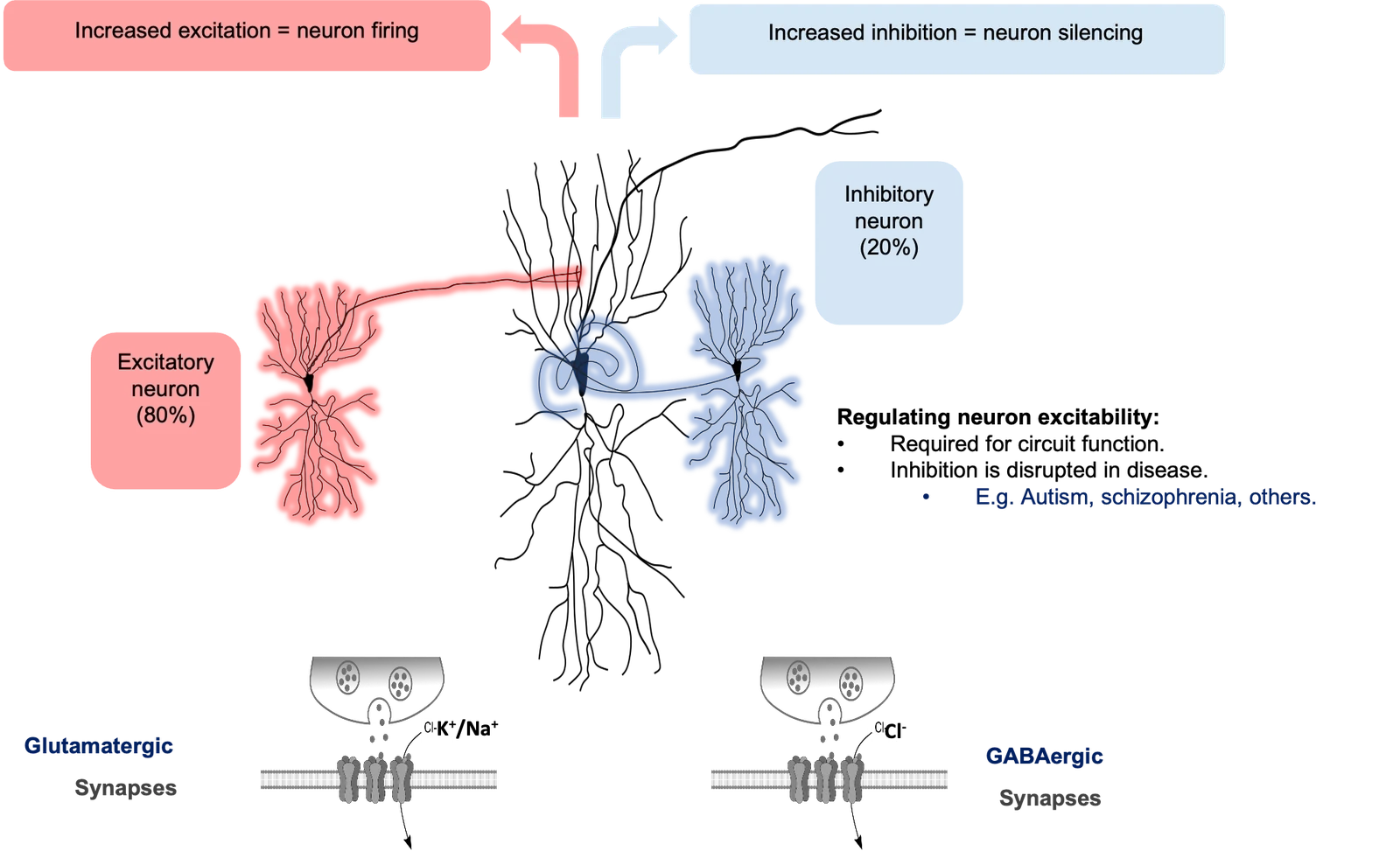
Excitatory neurons (80%) increase firing through glutamatergic synapses, while inhibitory neurons (20%) silence neurons through GABAergic synapses that conduct chloride. Inhibition is disrupted in diseases such as autism and schizophrenia.
Regulating neuron excitability. Excitatory and inhibitory inputs converge on each neuron; inhibition is disrupted in disorders such as autism and schizophrenia.

How we work

Next-generation omicsTranscriptomes and proteomes across brain states
Single-cell Patch-seqElectrophysiology and RNA from the same neuron
LC-MS/MS proteomicsPhosphorylation and synaptic proteome dynamics
Super-resolution imagingNanoscale organization of the inhibitory postsynapse
Viral gene deliveryCell-type-specific manipulation in vivo
Transgenic mouse modelsFrom scaffold mutants to circuit and behavior

Three mechanistic axes

How signaling scaffolds coordinate across compartments.

Extracellular matrix axis · Project 1

ADAMTSL3

The ECM regulates perineuronal net integrity to gate cortical plasticity across the lifespan. In the bone marrow niche it coordinates homeostasis, linking cancer and aging.

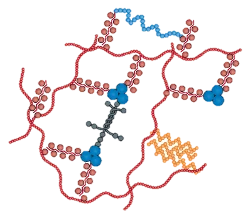
Molecular organization of a perineuronal net: a hyaluronan backbone decorated with chondroitin sulfate proteoglycans, link proteins and tenascin.
Molecular lattice of a perineuronal net

Key work: Cramer et al., Mol Psychiatry 2026 · Cramer et al., Cell Reports 2023

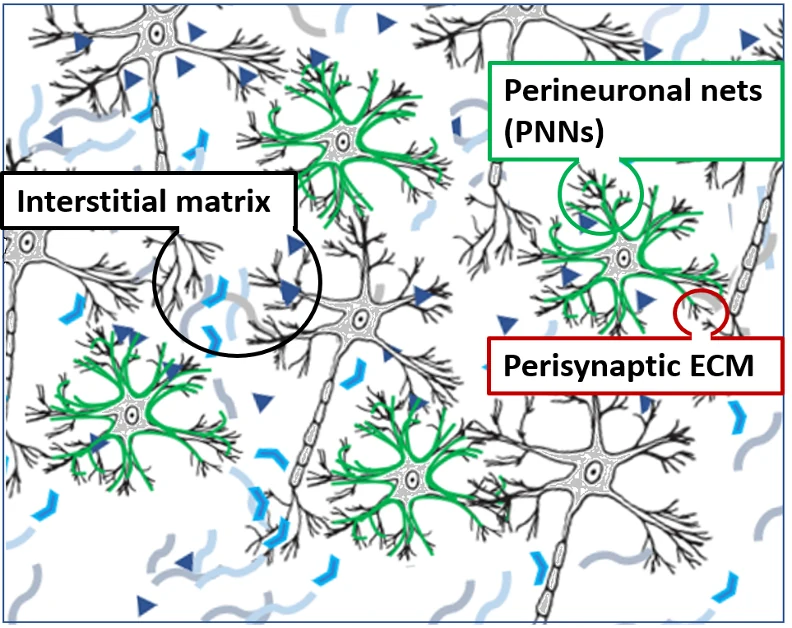
Three compartments of the brain extracellular matrix around neurons: perineuronal nets wrapping cell bodies and proximal dendrites, perisynaptic ECM at synapses, and the interstitial matrix between cells.
Perineuronal nets, perisynaptic ECM and interstitial matrix

Nuclear axis · Project 2

Nuclear speckles

Activity-driven nuclear condensates couple synaptic signaling to RNA-processing programs that govern sleep homeostasis and circuit-state transitions.

Key work: Noya et al., Science 2019 · Mircsof et al., Nat Neurosci 2015

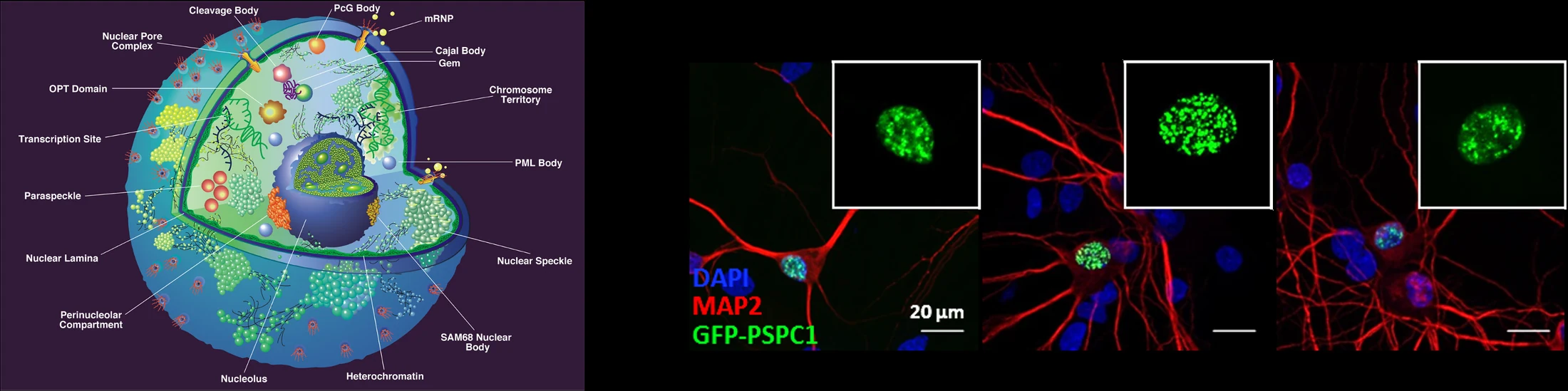
Left: illustration of nuclear bodies including nuclear speckles, paraspeckles, Cajal bodies, PML bodies and the nucleolus. Right: cultured neurons stained for DAPI (blue), MAP2 (red) and GFP-PSPC1 (green), showing PSPC1 paraspeckle puncta in neuronal nuclei; scale bars 20 µm.
Nuclear bodies (left) and GFP-PSPC1 paraspeckles in cultured neurons (DAPI, MAP2; scale bar 20 µm). Unpublished data, Tyagarajan Lab.

Synaptic / systemic axis · Project 3

Gephyrin

Synaptic scaffolding proteins extend their regulatory reach into nuclear transcription, brown-fat metabolism, redox balance, and sex-specific circadian physiology.

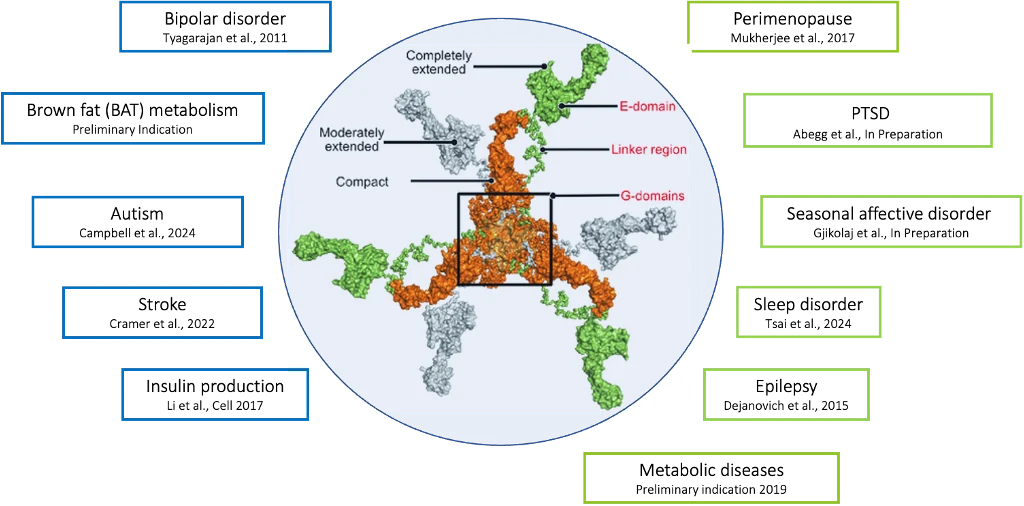
Gephyrin links to conditions ranging from bipolar disorder, autism, stroke and epilepsy to sleep disorders, perimenopause and metabolic disease.

Key work: Campbell et al., Mol Psychiatry 2024 · Tyagarajan & Fritschy, Nat Rev Neurosci 2014

Gephyrin trimer structure with G-domains, linker region and E-domains in compact, moderately extended and completely extended states, surrounded by linked conditions: bipolar disorder, brown fat metabolism, autism, stroke, insulin production, perimenopause, PTSD, seasonal affective disorder, sleep disorder, epilepsy and metabolic diseases.
Gephyrin conformations and the conditions they connect to. Unpublished data, Tyagarajan Lab.

Inside the GABAergic synapse

One scaffold. Many signals.

Gephyrin assembles beneath GABAA receptors into a lattice that kinases, phosphatases and SUMOylation remodel. Its state sets how strongly a neuron is inhibited and carries signals beyond the synapse.

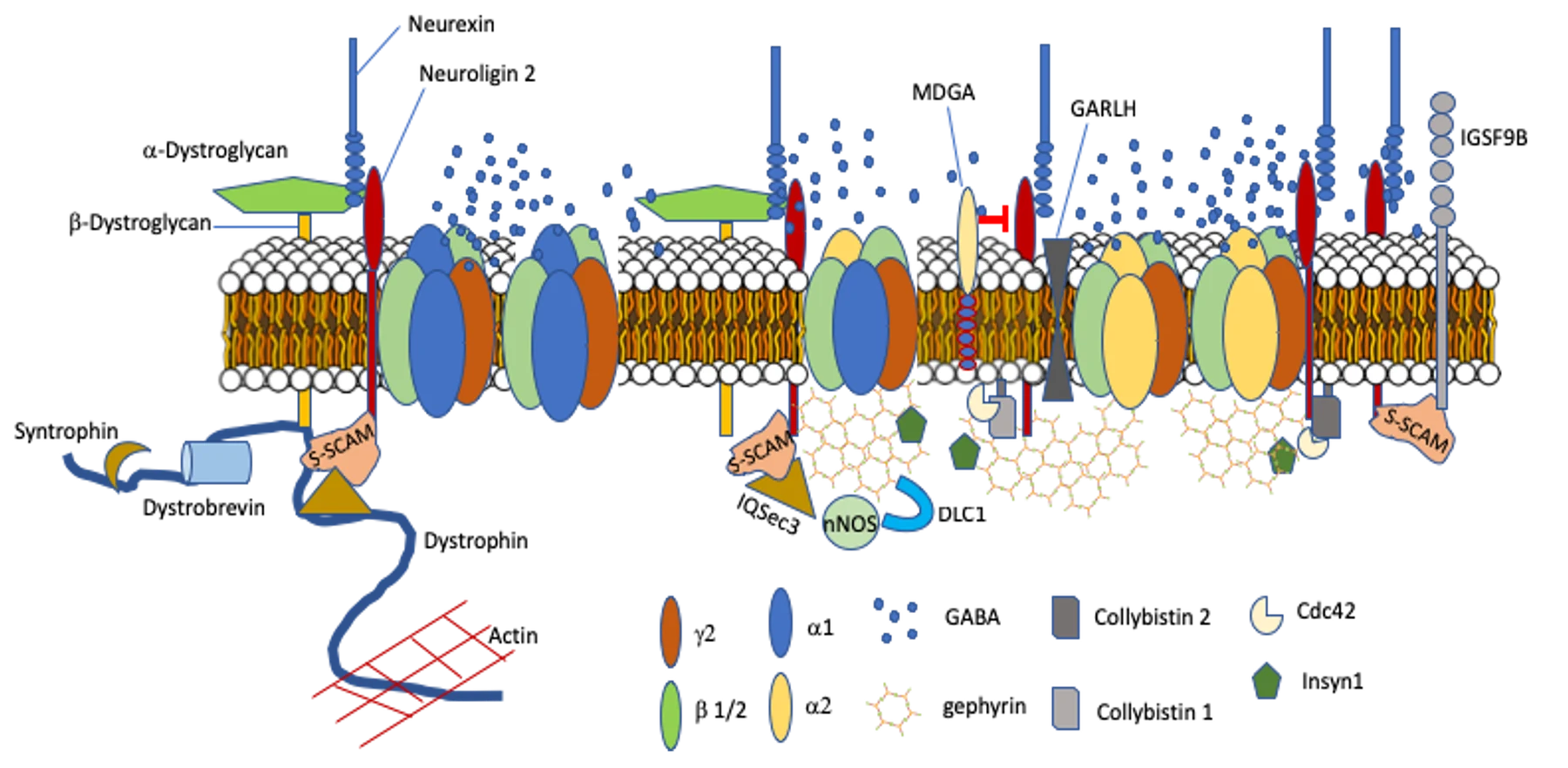
Schematic of GABAergic postsynapses: GABA-A receptors built from alpha1, alpha2, beta1/2 and gamma2 subunits anchored by a gephyrin lattice with collybistin, Cdc42, Insyn1, IQSec3, nNOS and DLC1; neuroligin 2, neurexin, MDGA, GARLH and IGSF9B at the membrane; and a gephyrin-independent synapse linked to the dystroglycan–dystrophin complex and actin.

Protein heterogeneity at GABAergic postsynapses. GABAAR subunits assemble differentially into heteropentameric receptors. Gephyrin, the main scaffolding protein at inhibitory postsynaptic sites, interacts with diverse cytosolic and membrane proteins to form a signaling network. Collybistin, which exists as several splice isoforms, is the only RhoGEF known to drive inhibitory synapse assembly through gephyrin. Gephyrin-independent GABAergic synapses also exist (left), and how they are assembled and maintained is still unclear. Several protein complexes that support trans-synaptic signaling have been uncovered in recent years.

Publications

Five key papers.

  1. 2026
    Schizophrenia-associated glycoprotein Adamtsl3 regulates perineuronal net formation, maintenance, and adult cortical plasticity

    Cramer TML, Hannan SB, Pretre L, Bear MF, Hensch TK, Tyagarajan SK

    Molecular Psychiatry · Published 11 June 2026

  2. 2024
    Gephyrin phosphorylation facilitates sexually dimorphic development and function of parvalbumin interneurons in the mouse hippocampus

    Campbell BFN, Cruz-Ochoa N, Otomo K, Lukacsovich D, Espinosa P, Abegg A, Luo W, Bellone C, Földy C, Tyagarajan SK

    Molecular Psychiatry 29:2510–2526 · Open access

  3. 2022
    Cross-talk between GABAergic postsynapse and microglia regulate synapse loss after brain ischemia

    Cramer T et al., Tyagarajan SK

    Science Advances

  4. 2019
    The forebrain synaptic transcriptome is organized by clocks but its proteome is driven by sleep

    Noya SB et al., Tyagarajan SK, Brown SA

    Science

  5. 2014
    Gephyrin: a master regulator of neuronal function?

    Tyagarajan SK, Fritschy J-M

    Nature Reviews Neuroscience

Over 50 publications on inhibitory synapses, gephyrin, the extracellular matrix and sleep.

People

The lab.

Portrait of Prof. Dr. Shiva Tyagarajan

Prof. Dr. Shiva Tyagarajan

Principal Investigator · Biochemistry of Brain Diseases

Shiva studies how synaptic proteins act at and beyond the synapse to shape brain circuits, behavior and vulnerability to disease. Before joining CNC-UC, he worked at the Institute of Pharmacology and Toxicology, University of Zurich, where much of the lab's research on the inhibitory scaffold protein gephyrin began.

PhD alumniDoctoral theses supervised
    MSc alumniMaster's theses supervised

      Open positions

      Join the lab.

      We welcome curious, rigorous people who want to connect molecules to circuits, behavior and disease.

      Master's

      MSc thesis

      A 9 to 12 month research project inside an ongoing study, or a new project with regular mentoring.

      • Synapse biology
      • Metabolism and disease
      • Human brain organoids

      Doctoral

      PhD thesis

      An independent project on one of the three mechanistic axes, from biochemistry to in vivo function.

      • Molecular biology and biochemistry, mouse genetics and viral tools
      • Omics, proteomics, Patch-seq
      • IHC and ICC along with near super-resolution microscopy

      Postdoctoral

      Postdoc

      Lead a research line and help shape the lab's direction, with support for fellowship applications.

      • Systems or molecular neuroscience
      • Computational and omics analysis
      • Translational pharmacology

      How to apply. Send a CV, a short statement of your research interests, and contact details for two referees. Please name the position in the subject line.

      shiva.tyagarajan@cnc.uc.pt

      Beyond the bench

      From synapse to therapy, and to the classroom.

      Lab spin-off venture

      Synaptique Therapeutics

      Founded by Shiva Tyagarajan to develop a new generation of precision CNS therapy. Through more than 18 years of research, the lab identified a novel way to modulate synapses through a scaffolding protein.

      The approach makes CNS treatment more targeted and widens the therapeutic window for drugs with novel, highly potent and non-addictive profiles. With a proprietary drug-screening platform, the team is now advancing hits into lead compounds.

      Target biology
      Screening platform
      Hit → lead
      Preclinical

      Science outreach · 2015–2020

      Science Xplore

      Shiva and his wife co-founded the non-profits Science Xplore (Portugal) and Science Xplore Suisse (Switzerland), where he served as Vice-President. From 2015 to 2020 they brought scientists and artists together to share science with young people aged 12 to 18.

      Working with researchers from the University of Coimbra and the University of Aveiro, and with Ciência Viva Portugal, they ran week-long ART LAB workshops during school breaks. The program ended in 2020 when the COVID-19 pandemic began.

      SummerEscola Secundária Alves Martins, Viseu, Portugal
      EasterInstitute of Pharmacology and Toxicology, University of Zurich

      Contact

      Find us.

      Address

      Center for Neuroscience and Cell Biology (CNC-UC)
      University of Coimbra
      Faculty of Medicine, Pólo I
      Rua Larga, 3004-504 Coimbra, Portugal

      Email

      shiva.tyagarajan@cnc.uc.pt

      Elsewhere

      CNC-UC profile
      DCV, Department of Life Sciences
      ORCID
      NCBI bibliography
      LinkedIn